
Skip to content
QMS Asset Integrity
Tensile Testing services across Australia
arrow_back All Services Mechanical Testing

Tensile Testing

Tensile testing of metals and welds to determine yield strength, ultimate tensile strength, elongation and reduction of area for material certification and weld qualification.

Overview

Tensile testing is the most fundamental mechanical test for determining the strength and ductility of metallic materials. By pulling a prepared specimen to failure under controlled conditions, the test measures yield strength, ultimate tensile strength (UTS), elongation and reduction of area - the key mechanical properties specified in material standards, design codes and welding procedure qualifications.

QMS Asset Integrity performs tensile testing at our mechanical testing laboratory for parent material certification, weld procedure qualification (transverse and all-weld-metal tensile tests), production quality control and failure investigation.

Our testing covers a wide range of ferrous and non-ferrous materials, with specimen preparation and testing performed in accordance with ASTM E8/E8M, AS 1391, ISO 6892 and the requirements of applicable fabrication codes including ASME IX, AS 3992, AS/NZS 1554 and AWS D1.1.

Tensile Testing inspection work
In the field

Tensile Testing Capability

Our technicians pair practical site experience with NATA-accredited processes, giving clients clear inspection data, traceable reporting and confidence in every result.

Methodology

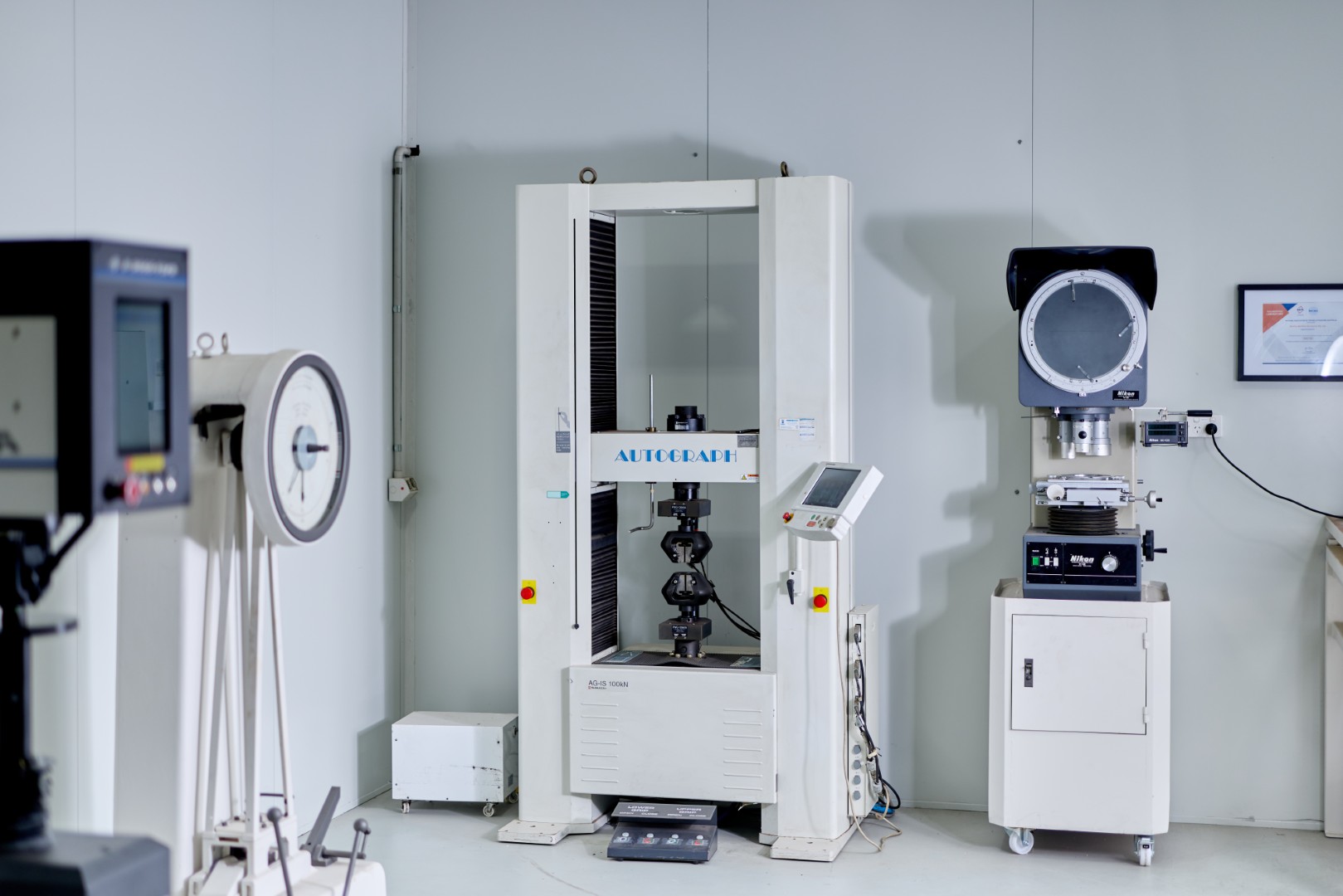
A machined specimen of specified gauge length and cross-sectional area is gripped in the jaws of a universal testing machine and subjected to a controlled uniaxial tensile load until failure. The machine records the applied force and the resulting extension throughout the test.

From the resulting stress-strain data, the following properties are determined: yield strength (the stress at which permanent deformation begins), ultimate tensile strength (the maximum stress sustained), elongation (the percentage increase in gauge length at fracture) and reduction of area (the percentage decrease in cross-sectional area at the fracture point).

Specimen types include standard round bar (proportional and non-proportional), flat plate specimens, and transverse weld specimens with the weld located at the centre of the gauge length.

Advantages

check_circle Determines all fundamental mechanical properties in a single test
check_circle Essential for material certification and incoming material verification
check_circle Definitive pass/fail for weld procedure and welder qualification
check_circle Covers ferrous and non-ferrous materials
check_circle Specimen preparation and testing under one roof
check_circle Compliant with all major Australian and international testing standards

Applications

  • arrow_right Welding procedure qualification (transverse and all-weld-metal tensile)
  • arrow_right Material certification and mill test report verification
  • arrow_right Production test coupon assessment
  • arrow_right Incoming material verification for critical applications
  • arrow_right Failure investigation and root cause analysis
  • arrow_right Elevated temperature tensile testing (where specified)

Applicable Standards & Codes

description ASTM E8/E8M - Standard test methods for tension testing of metallic materials
description AS 1391 - Metallic materials - Tensile testing at ambient temperature
description ISO 6892-1 - Metallic materials - Tensile testing - Part 1: Room temperature
description ASTM A370 - Standard test methods and definitions for mechanical testing of steel products
description ASME IX QW-150 - Tension tests for weld procedure qualification
description AS/NZS 2205.2.1 - Methods of destructive testing of welds - Transverse butt tensile test

Ready to Ensure Your Asset Integrity?

Partner with a NATA-accredited team delivering complete asset integrity - from inspection and testing through to remediation, coatings and certification.