
Skip to content
QMS Asset Integrity
Magnetic Particle Inspection (MPI) services across Australia
arrow_back All Services NDT Services

Magnetic Particle Inspection (MPI)

AC magnetic flow magnetic particle inspection for surface and near-surface defect detection on ferromagnetic components.

Overview

Magnetic Particle Inspection (MPI) is a fast, reliable and cost-effective NDT method for detecting surface-breaking and near-surface defects in ferromagnetic materials. QMS Asset Integrity delivers NATA-accredited MPI services using AC magnetic flow techniques across a wide range of industrial assets.

MPI is essential for weld toe cracking detection, fatigue crack identification on structural members, and quality verification during fabrication. Our technicians are experienced across the oil and gas, marine, mining, and manufacturing sectors, performing both workshop and field inspections to support your asset integrity programme.

The method is particularly valuable during shutdown inspections and turnarounds where rapid, reliable surface inspection of critical welds and components is required.

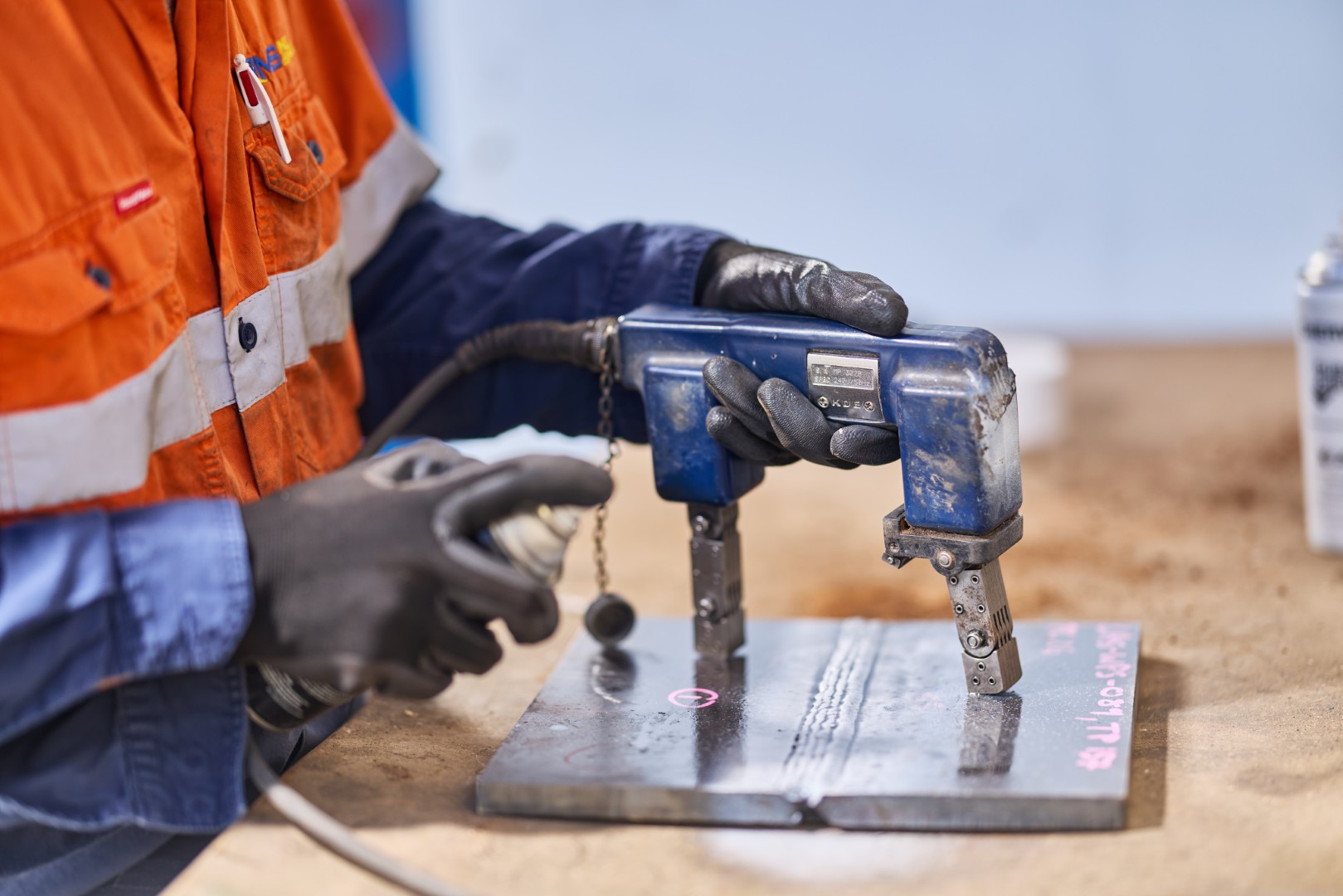
Magnetic Particle Inspection (MPI) inspection work
In the field

Magnetic Particle Inspection (MPI) Capability

Our technicians pair practical site experience with NATA-accredited processes, giving clients clear inspection data, traceable reporting and confidence in every result.

Methodology

MPI works by inducing a magnetic field in the ferromagnetic test piece using an electromagnet, yoke, or prods. If a surface or near-surface discontinuity is present, it disrupts the magnetic flux and creates a leakage field at the surface. Fine ferromagnetic particles - applied as a dry powder or in a liquid suspension - are attracted to this leakage field, forming a visible indication that reveals the size, shape and orientation of the defect.

QMS uses AC magnetic flow techniques, which are optimal for detecting surface-breaking defects. Inspections can be performed under white light (visible contrast particles) or UV-A light (fluorescent particles) for enhanced sensitivity.

Advantages

check_circle Rapid inspection with immediate visual results
check_circle Highly sensitive to tight surface-breaking cracks
check_circle Low cost and minimal equipment requirements
check_circle Can be performed through thin coatings
check_circle No ionising radiation or complex safety requirements
check_circle Portable - suitable for field and workshop use

Applications

  • arrow_right Weld toe and HAZ crack detection
  • arrow_right Fatigue crack inspection on structural members and lifting equipment
  • arrow_right Fabrication weld quality verification
  • arrow_right Casting surface inspection
  • arrow_right Shutdown and turnaround inspection campaigns

Applicable Standards & Codes

description AS 2062 - NDT - Magnetic particle testing of ferromagnetic products, components and structures
description ISO 9934 - NDT - Magnetic particle testing
description ASME V Article 7 - Magnetic particle examination
description AS 3788 - Pressure equipment in-service inspection
description AWS D1.1 Section 6 - Inspection requirements

NATA Accredited Scope

NATA
18957

NATA-accredited under ISO/IEC 17025:2017 (Accreditation No. 18957, Site 21253). Products: metallic surfaces - magnetic. Determinant: defect detection and characterisation. Technique: AC magnetic flow.

View full scope of accreditation arrow_forward

Ready to Ensure Your Asset Integrity?

Partner with a NATA-accredited team delivering complete asset integrity - from inspection and testing through to remediation, coatings and certification.