
Skip to content
QMS Asset Integrity
Hardness Testing services across Australia
arrow_back All Services Mechanical Testing

Hardness Testing

Hardness testing of metals, welds and heat-affected zones using Vickers, Brinell and Rockwell methods for material verification, weld qualification and in-service assessment.

Overview

Hardness testing measures the resistance of a material to localised plastic deformation caused by an indenter under a specified load. It is one of the most widely performed mechanical tests in the metals industry, providing rapid and reliable data for material identification, weld qualification, quality control and in-service integrity assessment.

QMS Asset Integrity provides hardness testing using Vickers, Brinell and Rockwell methods at our laboratory, as well as portable hardness testing on-site for in-service equipment. Hardness surveys across weld metal, heat-affected zone (HAZ) and parent material are routinely performed to verify compliance with maximum hardness limits specified in welding procedures, fabrication codes and client specifications.

Hardness data is critical for assessing susceptibility to hydrogen-induced cold cracking (HICC), stress corrosion cracking (SCC) and sulphide stress cracking (SSC) in sour service environments.

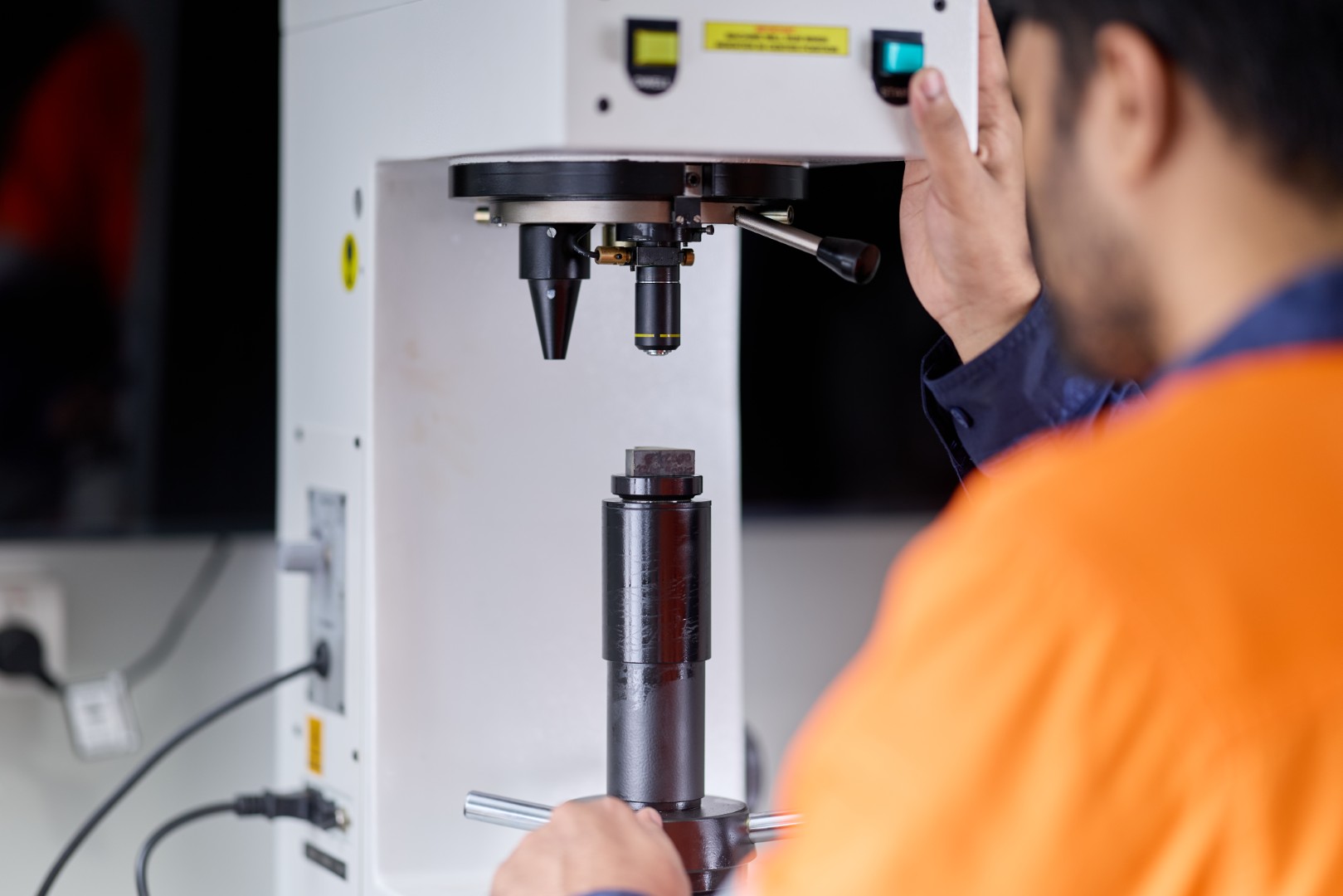
Hardness Testing inspection work
In the field

Hardness Testing Capability

Our technicians pair practical site experience with NATA-accredited processes, giving clients clear inspection data, traceable reporting and confidence in every result.

Methodology

Vickers Hardness (HV): A diamond pyramid indenter is pressed into the surface under loads from 1 kgf to 120 kgf. The diagonal lengths of the resulting impression are measured under magnification to calculate the hardness number. Vickers is preferred for weld and HAZ hardness surveys due to its small impression size, allowing precise measurement across narrow zones.

Brinell Hardness (HB): A hardened steel or tungsten carbide ball (typically 10 mm diameter) is pressed into the surface under a specified load (typically 3000 kgf for steel). The diameter of the resulting impression is measured to calculate the hardness. Brinell is suited to testing larger, less localised areas and coarser-grained materials.

Rockwell Hardness (HR): An indenter (diamond cone for HRC, steel ball for HRB) is applied under a preliminary load followed by a major load. The depth of penetration under the major load, referenced from the preliminary load position, directly gives the hardness reading on the instrument dial. Rockwell provides rapid results and is widely used for production quality control.

Advantages

check_circle Multiple methods (Vickers, Brinell, Rockwell) to suit different applications
check_circle Vickers provides precise HAZ and weld hardness mapping
check_circle Portable equipment for on-site in-service hardness surveys
check_circle Rapid results for production quality control
check_circle Critical data for sour service and HICC/SCC susceptibility assessment
check_circle Laboratory and field testing capability

Applications

  • arrow_right Weld procedure qualification hardness surveys (weld, HAZ, parent)
  • arrow_right In-service hardness testing for fitness-for-service assessment
  • arrow_right Sour service compliance verification to NACE MR0175
  • arrow_right Material identification and grade verification
  • arrow_right Production quality control and incoming material checks
  • arrow_right Post-weld heat treatment effectiveness verification

Applicable Standards & Codes

description ASTM E92 - Standard test method for Vickers hardness of metallic materials
description ASTM E10 - Standard test method for Brinell hardness of metallic materials
description ASTM E18 - Standard test methods for Rockwell hardness of metallic materials
description AS 1817 - Metallic materials - Vickers hardness test
description ISO 6507 - Metallic materials - Vickers hardness test
description ISO 6506 - Metallic materials - Brinell hardness test
description ASTM E140 - Standard hardness conversion tables
description NACE MR0175/ISO 15156 - Materials for use in H2S-containing environments (hardness limits)

Ready to Ensure Your Asset Integrity?

Partner with a NATA-accredited team delivering complete asset integrity - from inspection and testing through to remediation, coatings and certification.